Where do you go, if you have a pressing question? Today, 83% of people prefer to use artificial intelligence (AI) over Google for its convenience and efficiency, according to Yahoo. Increasingly, life without AI is getting hard to imagine. But, behind the ease of getting answers lies a cost that our planet is paying for.
The development and use of AI has led to a rise in energy consumption, water and other resources. According to an article from Columbia University magazine, AI contributes to around 2.5 to 3.7 % of carbon emissions, more than what planes emit each year.
Most people are unaware of the environmental effects of using AI.
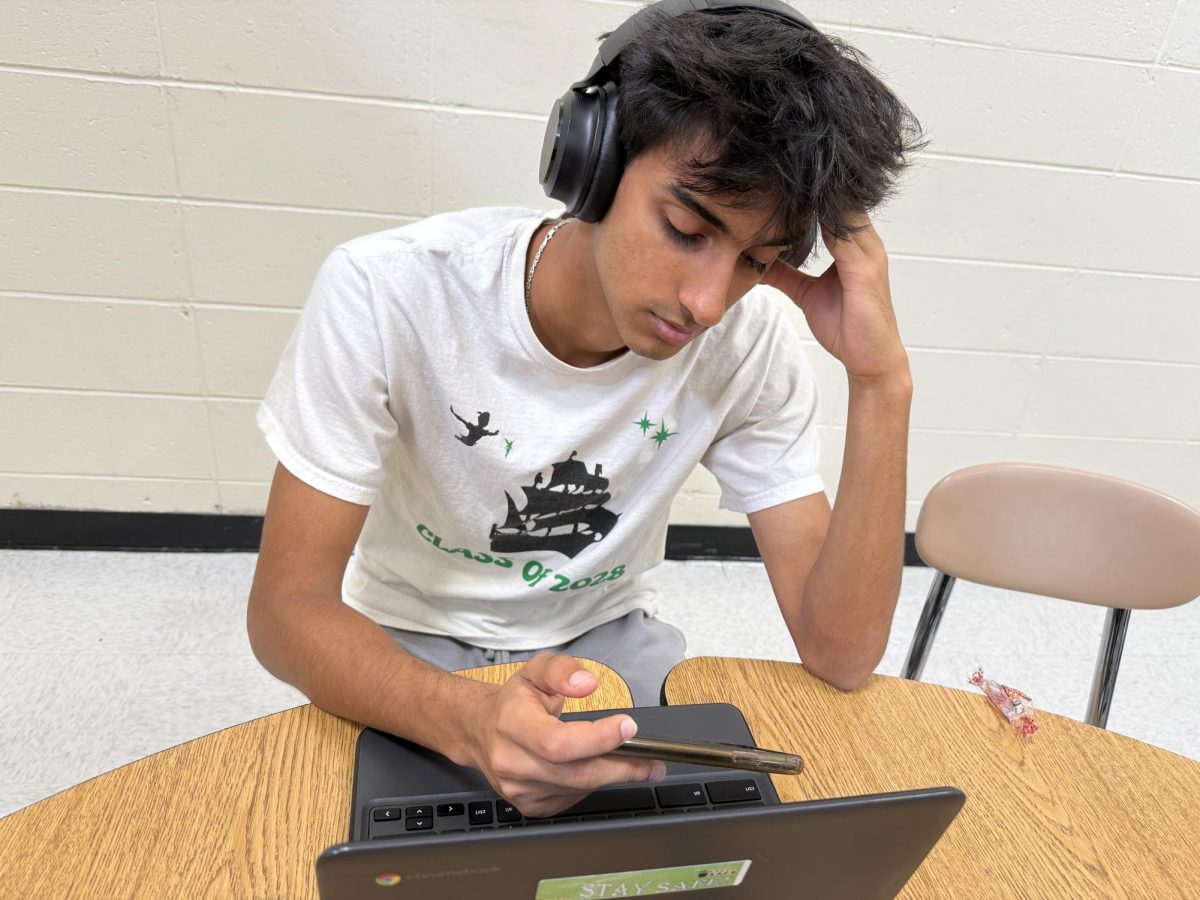
AI has become a necessity for staff and students as a tool to get through their day-to-day lives. Mikita Zhuk (‘27) said, “I usually just use it for helping, like making a mini quiz.”
At South, AI is becoming a classroom resource for teachers. “In our district, we give teachers the freedom to use AI as they want, ” said Mr. Peter James, Director of Technology.
Mr. James explained, “Chat bot tools and AI tools all have to be trained, and that training comes on graphics processing units and all kinds of really high-end computing devices.” All of this requires energy. According to Forbes, ChatGPT’s daily electricity usage equals as much as that used by 180,000 American households. According to a 2024 report by the Lawrence Berkeley National Laboratory, AI is consuming 4.4% of all energy usage in the U.S. This number will almost double to 8% by 2030, according to a report from Goldman Sachs, an investment banking firm.
Using this amount of energy and its production causes a lot of carbon emissions. What’s worrying is that these are just estimates. “We know the companies are hiding how much energy it takes to generate however much compute they’re talking about,” said Mr. James.
The impact doesn’t stop with electricity. According to an article on Bloomberg online, an AI data center uses on average 560 billion liters of water annually to cool its center. This number is expected to reach 1.2 trillion by 2030.
“This will hurt people living close to data centers,” said Nora Payak (‘28).
With AI deeply ingrained in our society, many are beginning to question whether the environmental impacts outweigh the benefits.
“After finding out more and doing more research on the impacts, it’s not worth it for me at all,” said Payak. “It can be helpful and it’s a great resource if it also wasn’t hurting the environment and so many people’s lives,” she said.
Others feel that AI is inevitable. “There is no way back from using AI,” said Zhuk. “It’s getting bigger–it’s expanding”.
As students, many are trying to find a balance by not overusing AI. “It shouldn’t be your first resort,” said Payak.
Zhuk agreed, “I think it’s fine to use it in school as long as you control yourself.”
On a larger scale, there’s hope that the new innovation in AI will align with sustainability concerns. “I really do hope that while the increase of AI usage has gone up, finding sustainable resources for solving these tasks also increases at a similar rate,” said Mr. James.
Awareness is the first step to living sustainably with AI. As Mr. James said, “West Windsor students should talk about these things.”
We should talk about living sustainably with our friends and family. We should ask them: Is typing out that AI prompt really worth it?