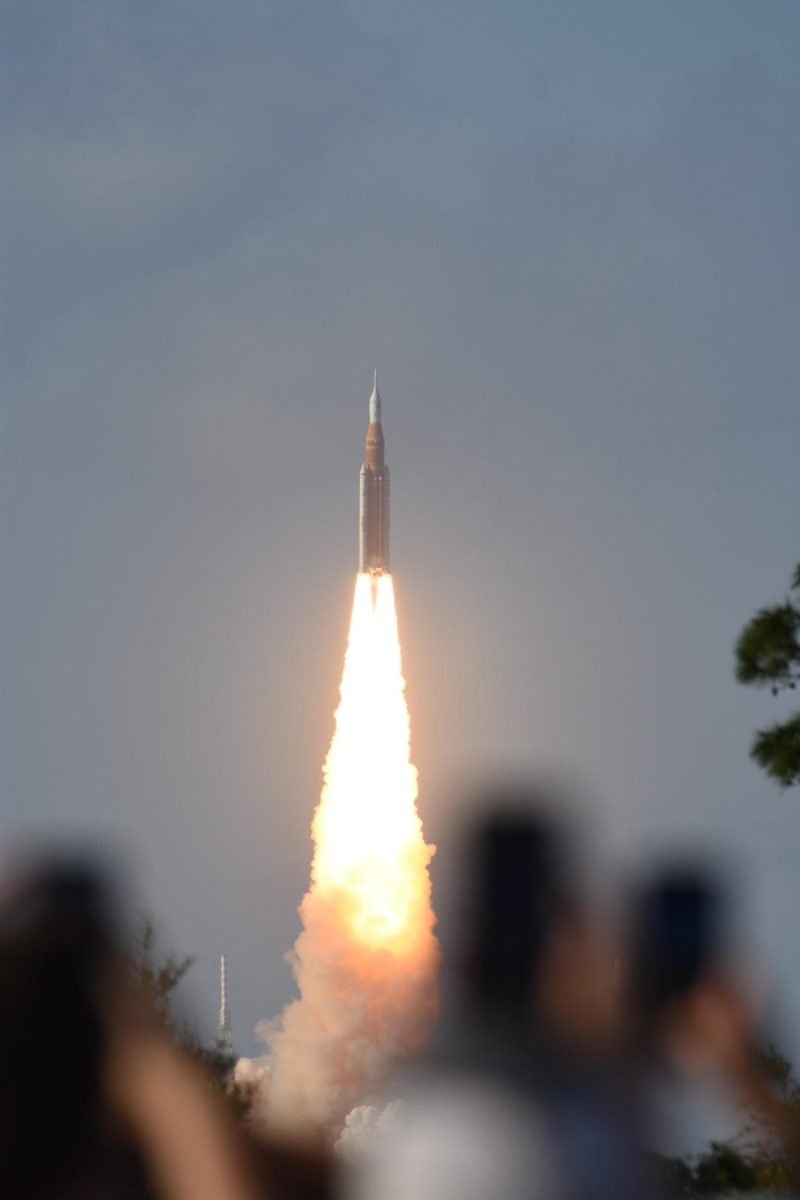
The Artemis II launch sounded like a “crack in the sky,” said Krishiv Sharma (‘27), who watched the ship launch from the Kennedy Space Center in Florida on April 1 and saw the 8.8 million pound rocketship as it started its 694,481 mile journey to the moon.
Ten days after its departure, Artemis II splashed down in the Pacific Ocean. The mission set the world record for farthest crewed spaceflight. As the first mission to take astronauts to the moon since 1972, the journey was full of historic milestones.
Four astronauts made up the crew of the Orion spacecraft: mission commander Reid Wiseman; pilot Victor Glover, the first Black astronaut to pilot around the moon; mission specialist Christina Koch, the first woman to travel to the moon; and mission specialist Jeremy Hanson, the first Canadian to leave Earth’s orbit.
The astronauts spent close to three years practicing to pilot the ship, according to CBS News online. Preparation for the mission required years of “shake and bake,” which is training that simulates the ship’s durability to see if it can endure the violent vibrations of the launch and the extreme temperatures of space, according to NASA online.
The launch of Artemis II became popular online. One of the mission’s most viral moments was when the crew named a lunar crater after Commander Wiseman’s late wife, Carroll, who died of cancer in 2020.
“After hearing their story, I wanted to see them succeed even more,” Mukhija said.
Artemis II is part of a series of five missions called the Artemis program that aims to return astronauts to the moon. The first mission was in 2022 with the launch ofArtemis I. Artemis V is scheduled to launch in 2028.
Sharma said that returning astronauts to the moon will provide opportunities to learn more about the moon. These missions will lay the groundwork for establishing a permanent lunar base–a facility for astronauts to inhabit and conduct research during their missions, according to NASA online.